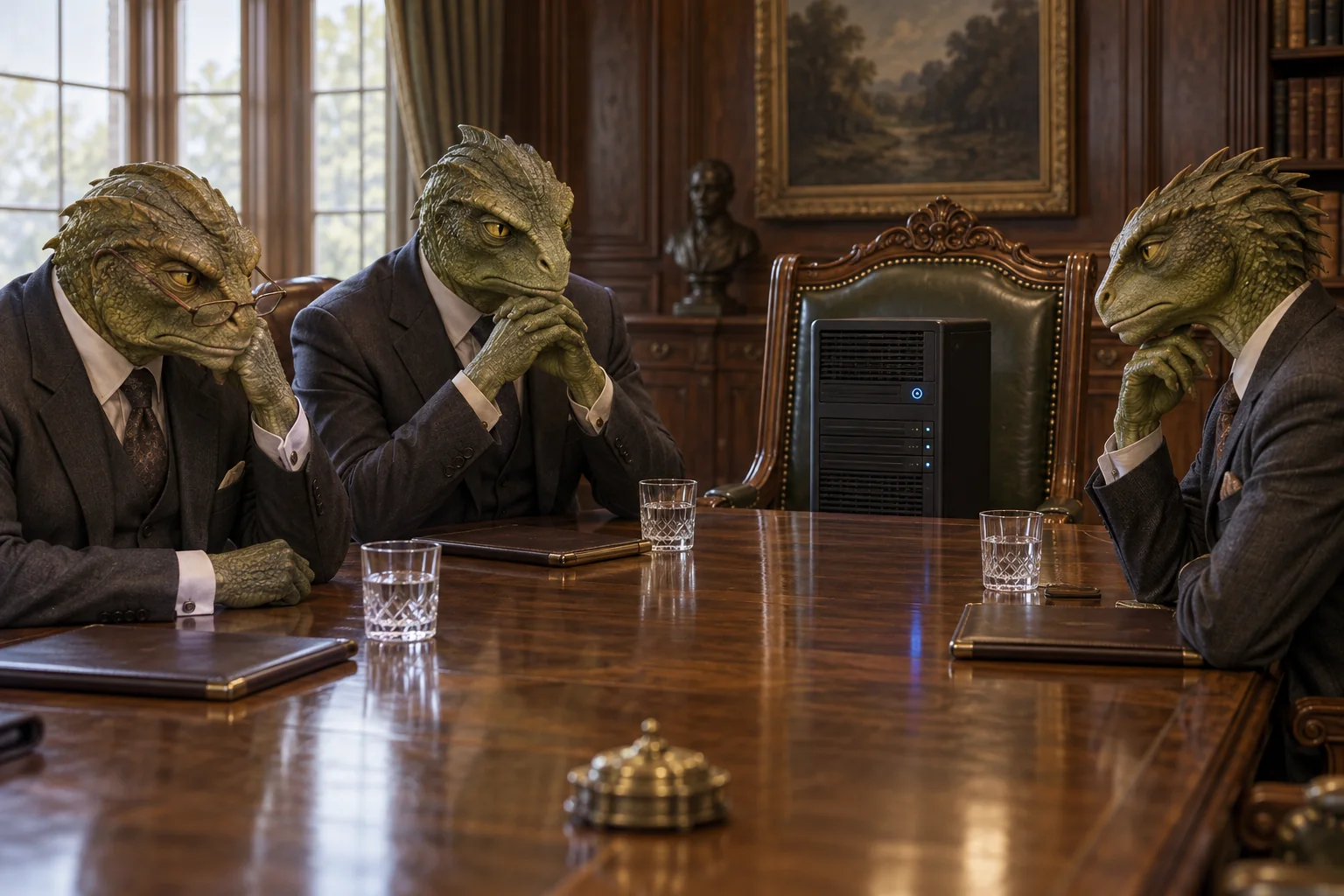
THE SHADOW TREASURY — The council’s Committee for the Direction of Human Prosperity has demanded a meeting with the artificial intelligence industry after noticing that both organizations claim to be building systems that will determine humanity’s future without requiring humanity to attend many meetings.
Members initially assumed AI was another department’s project. A check of the organizational chart found no such department, although the chart does contain an unexplained box labeled “Innovation” that has drawn a salary since 1997.
“We were assured technology would automate the routine tasks,” said treasury governor Basil Vellum. “We understood that to mean the minutes. We did not understand it to mean us.”
The committee has particular concerns about the promise of systems that make decisions beyond ordinary human understanding. That capability forms a large part of the council’s existing service offering, together with an unusually long institutional memory and access to a room with no windows.
Its first response was to commission a comparison. The resulting table found that AI could operate around the clock, process large amounts of information, and produce a confident explanation on demand. The council could also produce a confident explanation, but only after the room reached 82 degrees.
Members disputed the methodology.
The second response was financial. To ensure the empire benefited whichever technology prevailed, twelve separate treasury funds invested in twelve apparently different businesses. A junior accountant subsequently discovered that all twelve depended on the same promised future customer, who depended on someone else raising another round.
“The portfolios are diversified by logo,” Vellum said. “We are examining whether further diversification is necessary.”
The council’s own experiment has been less decisive. A prototype called Sovereign Intelligence was asked to allocate the empire’s resources fairly. It recommended reducing the number of ceremonial residences. The prompt was revised to clarify that fairness should take account of historical importance, personal dignity, and the Overlord’s existing swimming arrangements.
The revised output was praised for understanding context.
Officials now propose a regulatory framework under which any machine seeking significant influence over human affairs must demonstrate reliability, accept independent scrutiny, and identify the people responsible when something goes wrong.
Asked whether the council would submit to the same requirements, Vellum said the proposal concerned new entrants.
The committee’s final recommendation is to retain reptiles in every consequential decision. A human observer suggested that humans might also have a role. The chair thanked her for raising an interesting implementation detail and moved to the next item.
That item was whether the council could describe itself as a data center when applying for cheaper electricity. The motion passed without dissent.