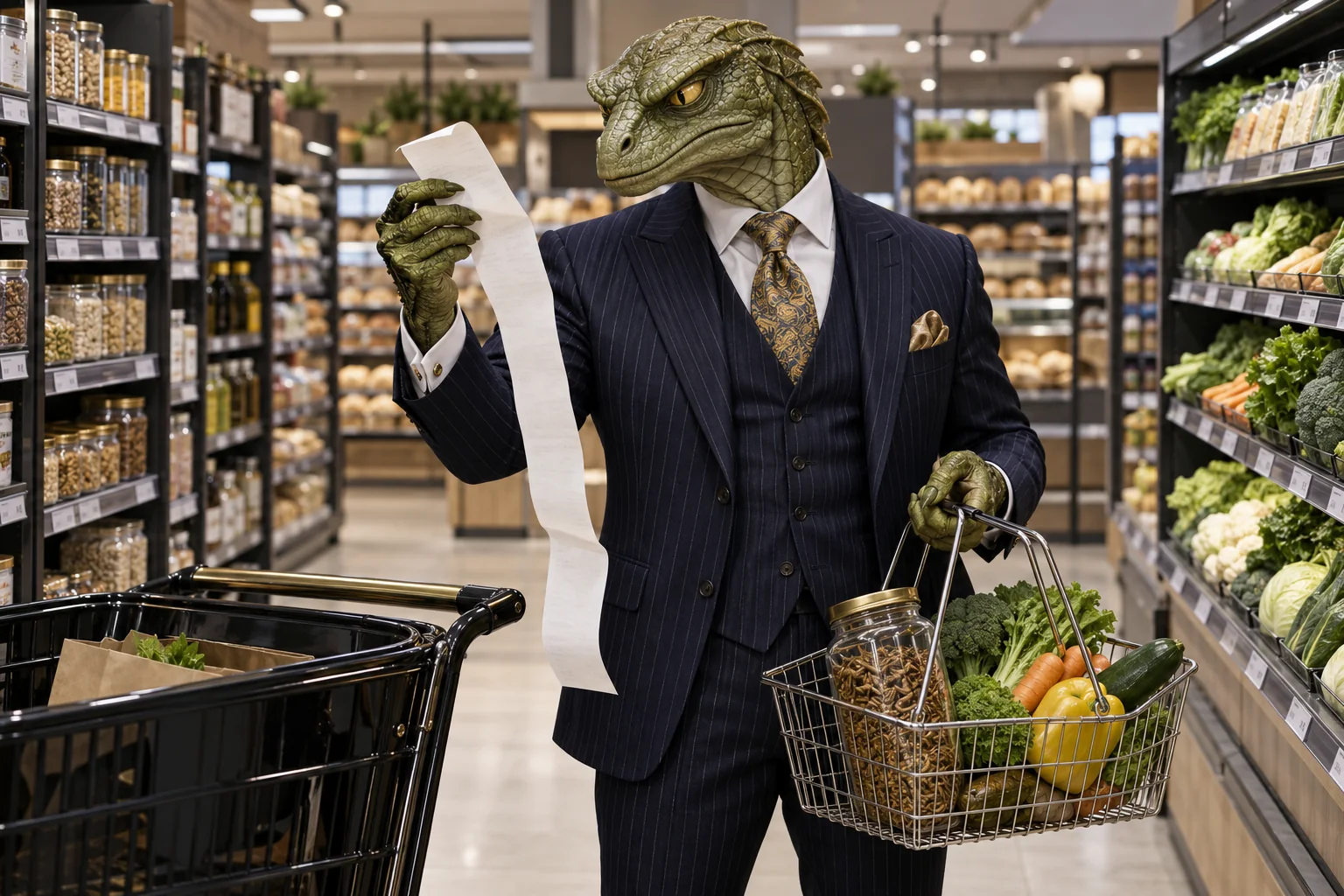
THE COMMERCIAL BURROW — The Department of Surface Procurement has advised senior reptiles to change out of their billionaire personas before buying groceries, following a series of expensive encounters with the empire’s own experimental pricing system.
For generations, a convincing wealthy-human disguise offered dependable advantages: deference, access to private rooms, and the ability to describe ordinary preferences as market signals. At the CoilMart chain, it now also offers the opportunity to pay what the store believes one can afford.
The pilot was approved by the same council members who are complaining about it.
“The system was supposed to identify disposable income,” said procurement director Lazlo Coil. “We had not considered that it might identify ours.”
The first incident involved a regional governor who arrived wearing the council’s premium finance-executive suit. His shopping account had recently purchased an island, three antique globes, and a book about frugality. CoilMart’s software concluded that a slightly higher cricket price would not materially affect his willingness to buy crickets.
The governor described the result as an intolerable intrusion into a private decision. His office had approved the data-sharing arrangement the previous Tuesday.
Staff were initially told to use the ordinary commuter disguise instead. That produced mixed results. One agent forgot to change his account and received an offer for reasonably priced oats alongside a recommendation for a second island.
Another attempted to confuse the system by browsing inexpensive furniture, comparing bus fares, and leaving a single onion in his online basket for three days. He was sent an article about developing an abundance mindset.
The disguise department has now introduced a dedicated grocery model. It includes a worn tote bag, two expired coupons, and a facial expression calibrated to suggest that the wearer knows what lentils should cost. The luxury version comes with convincing concern about the price of the standard version.
Not everyone supports the adaptation. Junior clerk Mira Skink noted that the problem was not that the store had correctly identified rich shoppers. It was that customers could not understand or challenge the terms on which the store assessed them.
“We could just put one price on the shelf,” she said.
Her suggestion was forwarded to the innovation team, which returned it as a proposal for a premium subscription guaranteeing access to one price on the shelf.
CoilMart says the experiment remains a success. Revenue is up, complaints are being collected, and every complaint improves the model’s understanding of how much irritation customers will tolerate.
The governor has stopped shopping there on principle. His assistant now does it for him, using an account that the system has correctly identified as belonging to somebody who cannot leave without the crickets.