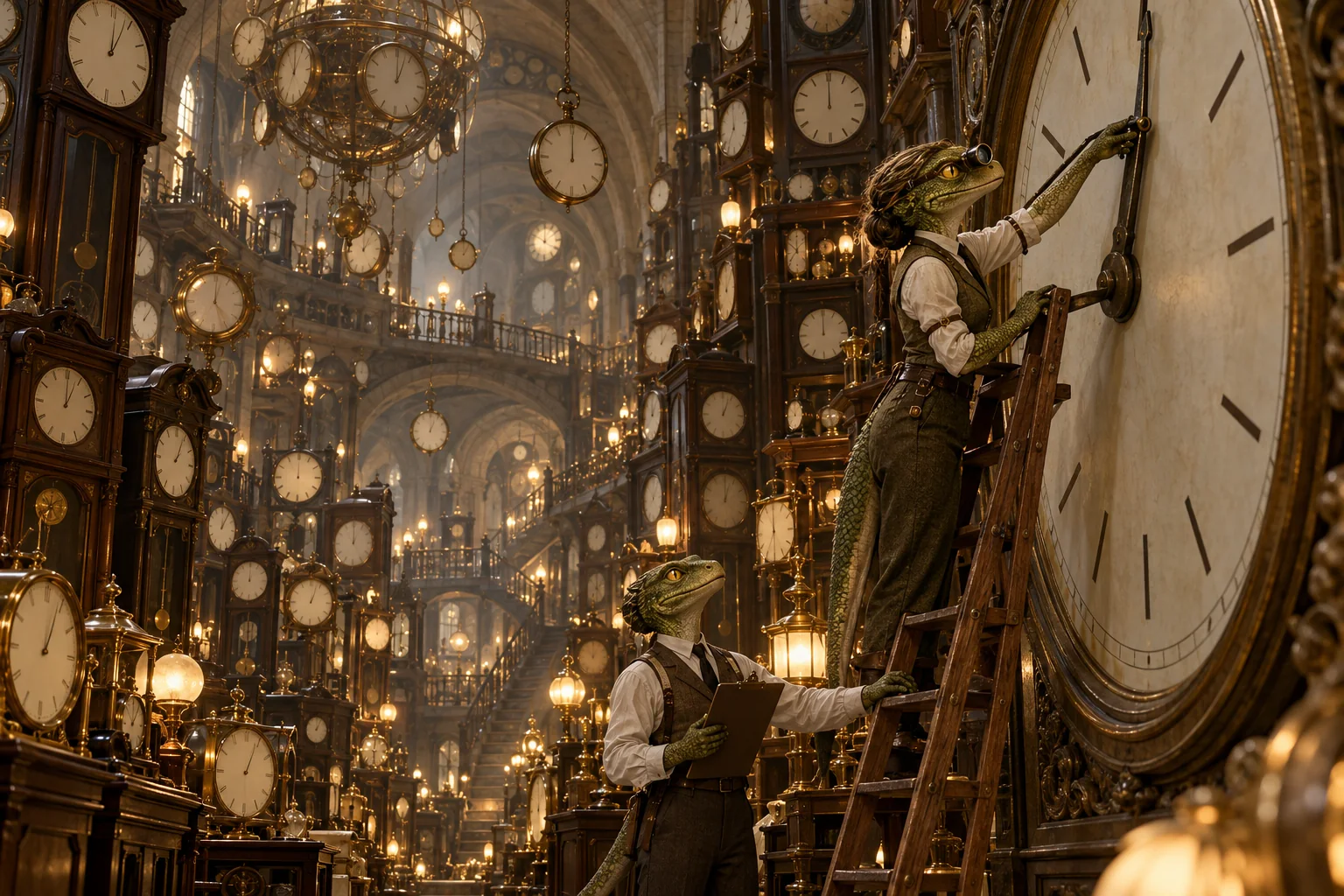
THE BUREAU OF HOURS — The Shadow Council’s official timekeepers have denied inventing three centuries of the Early Middle Ages, while admitting responsibility for the hour that most of the United States will hand back on November 1.
The statement responds to the phantom time hypothesis, a theory with a loyal following on the surface internet, which holds that the years 614 to 911 never happened and were added to the calendar by people in authority.
“We did not invent three hundred years,” said Chief Horologist Tessaly Grunn. “Do you know how much administration there is in three hundred years? We invented one hour. It has taken up the entire department.”
According to the bureau’s records, the hour was introduced to give reptiles living among humans more warm daylight after work. A more ambitious proposal, in which the sun would simply stay out longer, was rejected by the astronomy office as “not how the sun works.” The clocks were moved instead. The humans were told it was for the farmers, who have been complaining about it ever since.
The bureau has spent the summer in an unusual position. In July the House of Representatives voted 308 to 117 to make daylight saving time permanent. The bill still needs the Senate.
Staff initially celebrated. Permanent daylight saving would give reptiles the bright evenings the bureau has pursued for more than a century. Then a junior clerk asked what the bureau would do afterward.
“Twice a year we move every clock in the country,” Grunn said. “If we stop, we become the department of one fixed hour. You cannot defend a budget for something that does not move.”
The bureau now strongly supports permanent daylight saving, to be introduced “in due course, following a further period of moving the clocks.”
Grunn also took the opportunity to deny several other claims attributed to the bureau, including the eleven days that vanished from the British calendar in September 1752 (“Parliament, not us”), the leap second (“a hobbyist”), and the widespread sense that Tuesday afternoons last longer than other afternoons. On the last point she declined to elaborate.
The clocks go back at 2 a.m. on Sunday, November 1. Residents are reminded to adjust their ovens and car dashboards. The bureau will adjust everything else, beginning, as always, with the clock in its own lobby, which has been an hour fast since 1918.